Advertisement
It is always easier—and more profitable—to align oneself with existing wealth and power than to resist it on the principled grounds of justice, equity, or stewardship. While the pursuit of profit rewards speed, scale, and indifference, conservation demands restraint and the acceptance of limits. The incentives are fundamentally lopsided: on one side, the gains from exploitation are immediate, private, and compounding; on the other, the rewards of conservation are delayed, diffused, and socialized. Those who seek profit have the obvious motive and the ample means to dominate the discourse, while those who argue for restraint must expend their own time, resources, and credibility with no hope of reimbursement. It is asymmetrical warfare made personal.
Climate change politics is perhaps the largest and most literal theatre of this asymmetry. After centuries of fossil-fuel extraction, the planet has warmed beyond the narrow Holocene temperature range within which human civilization emerged. The inheritors of the same human character traits that created this condition continue to profit from its persistence. Wealth generated by exploitation easily drowns out scientific warnings with a louder, better-funded song of denial, delay, and distraction.
In this ideological conflict, the real “conservatives” are not those defending fossil-fueled profits, but their science-backed opponents attempting to conserve the natural ecosystems upon which life on Earth depends. The fight remains asymmetrical: one side stands on principle against another for whom principle is an inconvenient luxury—and an existential threat to private profit.
To name names: Bari Weiss and “ex-activist” Lucy Biggers of The Free Press (thefp.com) serve as modern archetypes of this "easy path." It is difficult to imagine a journal of serious environmental reporting commanding the $150 million reportedly paid to Weiss by David Ellison’s Paramount–Skydance, the new owners of CBS News. Is Ellison anti-environmental? Perhaps not inherently; but ideological alignment is easy, and it pays the rent. To be clear: the focus here is not on these individuals as people, but on the structural decay that occurs when media organizations align their incentives with power rather than truth.
CBS has created a structural coupling between professional reporting and ideologically driven commentary, much to the detriment of its own journalism. While CBS’s online news stories—at least as of January 2026—remain timely and professional, the Free Press articles tethered to the bottom of every environment page are anything but. These links direct readers toward climate-denialist commentary under the amusing lie, “Go deeper with The Free Press,” only to land them in a shallow pool of unscientific polemics.
Prominent among these offerings in January 2026 is Ted Nordhaus’s “I Thought Climate Change Would End the World. I Was Wrong.” Even as a confession of youthful naivety, the piece is barely of interest; it possesses neither the depth nor the relevance to engage with the actual rigor of climate science or the mounting pressure of climate reality.
But the superficiality goes much deeper. Alongside Nordhaus is a polemic by Bari Weiss’s entire editorial team, apparently: “The Cost of Confused Climate Science“, 3 December 2025 (paywalled). Their target is “alarmism,” and it quickly becomes clear that thefp.com is resolved to protect its readers from the unsettling conclusions inherent in the scientific method. The team seizes upon a recent retraction by the journal Nature regarding a paper on economic damages from global warming, branding it as part of a “long pattern” where scientists supposedly make “outsize claims in the hope of influencing public debate.”
Yet, no—this narrative is demonstrably false and the weight of published scientific literature actually evinces the exact opposite. For instance the history of the Intergovernmental Panel on Climate Change (IPCC) is characterized by constant upward revisions. Far from being hyperbolic, its projections for global warming and climate shift have been historically, and perhaps dangerously, conservative.
In a seminal 2013 study—now cited over 500 times—titled “Climate change prediction: Erring on the side of least drama?”, Brysse et al found “… scientists are biased not toward alarmism but rather the reverse: toward cautious estimates, where we define caution as erring on the side of less rather than more alarming predictions. We call this tendency “erring on the side of least drama (ESLD).” That is: scientific papers are almost universally written with a conservative bias, objectively favoring the least alarming predictions.
To be sure, the public advocacy of an individual is not an institutional projection of scientific consensus. While a scientist arguing for urgent action might select the evidence that most forcefully supports their case, the institutional reality is different: every national Academy of Science on Earth is unequivocal on the reality of human-induced global warming. This does not imply that every climate scientist is cautious in tone, nor that scientific communication is always free of heat. Instead, it reflects the well-documented tendency of institutional assessments to privilege consensus and methodological caution—often erring by marginalizing uncertain but high-impact risks until the evidence becomes overwhelming.
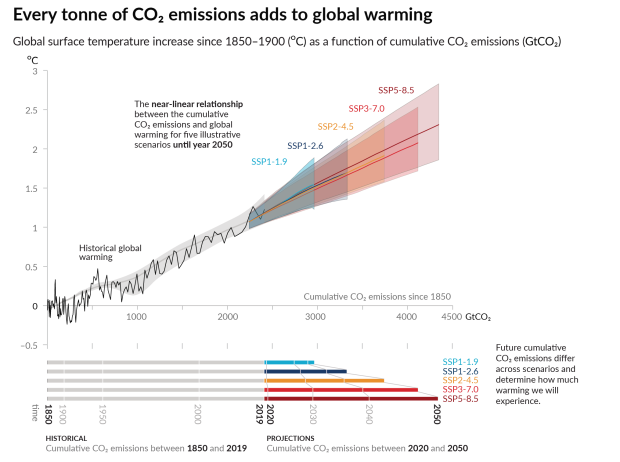
Take for instance the IPCC’s Fifth Assessment Report AR5 (2018) chapter regarding sea-level change. The report notes that confidence in sea-level rise projections increased precisely because of "improved physical understanding" and the "inclusion of ice-sheet dynamical changes" that were previously omitted. The institutional history of the IPCC reports is the opposite of alarmist overreach, rather a steady, reluctant climb toward reality as physical risks became too undeniable to ignore. Processes initially dismissed as too uncertain to quantify—most notably rapid ice-sheet loss—have repeatedly proven to be real, measurable, and faster than the "drama-free" models allowed. Even the canonical CO₂–temperature relationship has proven unsettlingly accurate, tracking observed warming not overshooting it.
See image at bottom
Back at CBS, however, the Free Press editors turn their attention to the Great Barrier Reef, citing a 2022 statement from the Woods Hole Oceanographic Institution (WHOI) that “the reef is seeing its highest level of coral cover in 36 years.” Writing in 2025, the editors somehow fail to notice that the years immediately following that report—2023 and 2024—produced the most extensive and severe mass-bleaching events ever recorded. As 2025 unfolds under the same extreme thermal regime, relying on a selectively chosen data point while ignoring the subsequent years of record-breaking bleaching is … not real journalism.
Remarkably, the editors next go the extra mile to overlook the qualified opinions of the very scientists they cite. That same Woods Hole article explicitly warned that the apparent increase in coral cover was likely to be short-lived, referencing IPCC projections of a 70–90% global coral die-off once warming reaches 1.5 °C. Furthermore, the "recovery" reported in 2022 reflected a temporary proliferation of fast-growing, structurally simple, heat-tolerant species—"coral weeds," essentially—rather than the slow-growing, complex reef-builders whose loss defines genuine ecological collapse. To present this as evidence for their narrative is more than misleading; it inverts the actual meaning of the science while pretending to report it.
The editors conclude by weeping crocodile tears over how “the greatest cost is to science itself,” claiming the funding pot is drained by “climate agitprop” masquerading as scholarship. Their solicitude for scientific integrity is more than a little precious. Weiss’s reported $150 million payday was not remuneration for scientific contribution or epistemic care; it was a commercial investment in influential, pseudo-scientific contrarianism—an asset that David Ellison evidently hopes to monetize. To posture as defenders of science while cashing in on its systematic misrepresentation is not principled skepticism; it’s a grift.
Continuing in this vein, the editorial invokes a Wall Street Journal article on European energy costs as evidence that “bad science leads to bad policy.” Yet the article in question is not a scientific critique; it is a political-economic comparison of regional energy prices. Notably, the article does not engage with the scientific literature Weiss has spent so much ink disparaging, nor does it address Germany’s decision to shutter its nuclear power stations—a political choice made against the explicit advice of many climate scientists. To cite the European experience as evidence of scientific failure is to confuse policy disagreement with epistemic error. At most, it proves that energy transitions are politically contingent and difficult, without relevance or implications for the sciences.
Ultimately, Weiss’s Free Press is not interested in a defense of science; its business model favors distorting the field to boost the reach of pseudo-scientific influencers. The problem is not that science occasionally gets things wrong, but that powerful media actors pretend concern that science is failing while they’re complicit in systematically misrepresenting it. David Ellison isn’t at CBS for the science, nor are Bari Weiss or Lucy Biggers. There is no money in climate science, but there is some to be made in denying, subverting, and distracting from it.
In this environment, weaponized disinformation doesn’t need to defeat science on its merits; it only needs to exhaust it, crowd it out, or reframe it as just another partisan consumer preference. When media institutions abandon their responsibility to distinguish evidence from assertion, science becomes a political inconvenience—and therefore optional. What these players call “alarmism” is realistically the refusal of science to meet their denial with silence. It is a recognition that, in reality, science remains far more conservative than its motivated detractors are willing to understand.